New

Cognida acquires Automate to expand enterprise AI automation across finance and operations.

Read more
Right arrow
FDE+

One team. Three engines. Every engagement.

FDE+ completes forward-deployed engineering: cross-functional engineering to build, embedded leadership to shape the work, and the Zunō platform that starts every engagement months ahead. One team, accountable from strategy through production, at the cadence of a frontier lab and the audit standard of a Global 2000.

In partnership with Global 2000 leaders — across the industries where the cost of getting AI wrong is highest.

An engineer in the field is not an operating model

Whole job icon
THE WHOLE JOB

Forward-deployed engineering won the argument. Enterprises now expect their AI partners to build inside the business rather than present to it, and every serious provider, from the frontier labs down, fields embedded engineers. We were early to that conviction, and the industry’s arrival confirms it.

Standard FDE puts excellent engineers at the center of the problem, and that is where they belong. But an enterprise deployment is won before the build and after it. Someone has to turn a board’s intent into a strategy, design a solution the organization can actually run, and convince a thousand people to change how they work. The build should not start from zero. Evals, governance, and deployment have been built a hundred times before; they should arrive ready on day one. And when the model drifts in month nine, the team that made the promises should still be in the room.

The plus in FDE+ is not branding. It is the part of the model that was missing.

FDE+ meets that standard. Embedded leadership owns the strategy, the design, and the adoption. Cross-functional engineering covers every layer of the build. The Zunō platform starts the engagement months ahead. And the team stays through operations, accountable to your leadership, finished only at handoff.

What the plus is made of

Every engagement fields the same three engines: leadership that shapes the work and carries adoption, engineering that spans the full stack, and a platform that arrives with the groundwork done. They run as one team, with one accountable lead.

Embedded leadership

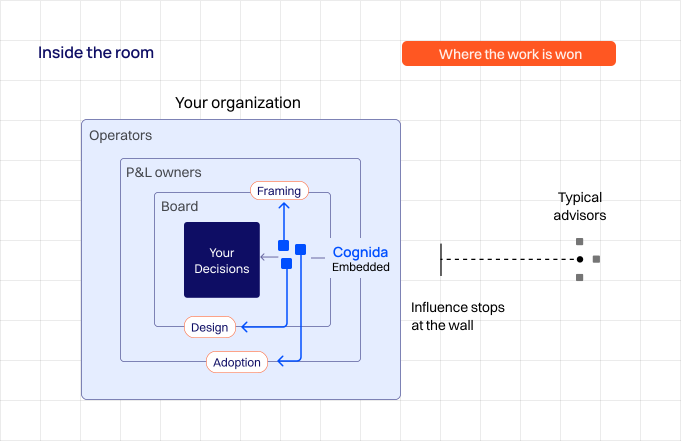
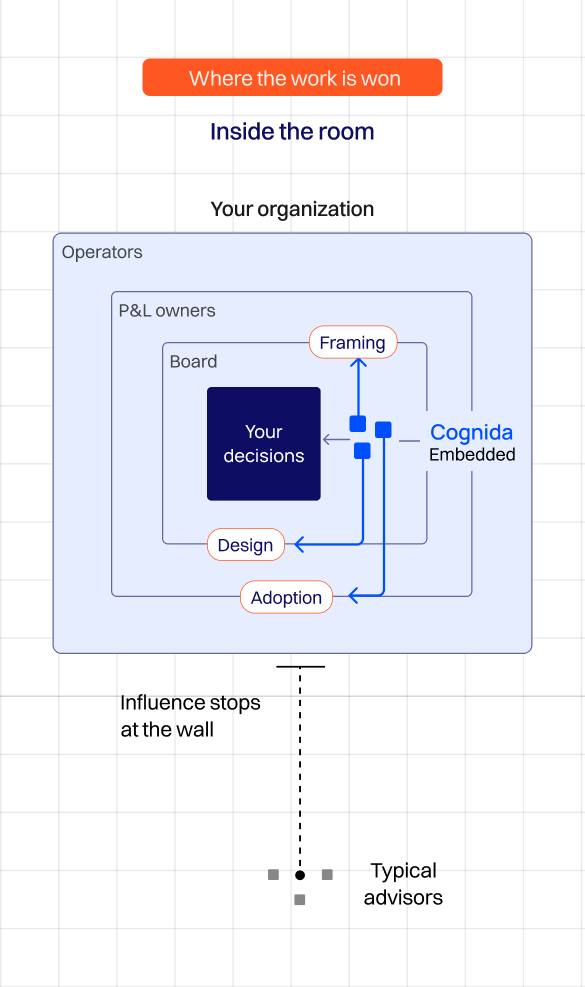
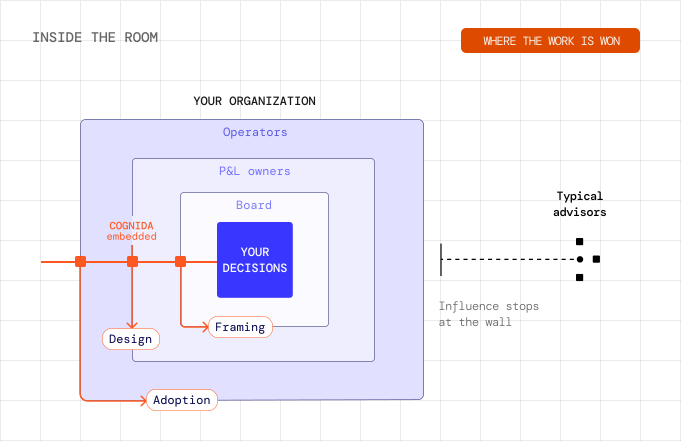
AI strategists and principal architects who work from inside your organization for the length of the engagement. They turn board intent into strategy, design solutions your organization can run, and lead the adoption work that decides whether any of it matters: the workflows, the operating rhythm, the people whose day changes.
  • Senior AI strategists, fluent in the boardroom and the build.
  • Principal architects across AI, data, applications, and integration.
  • On site or fully embedded, matched to your operating rhythm.
  • Accountable to your leadership, not to a change-order process.
img

Cross-functional engineering

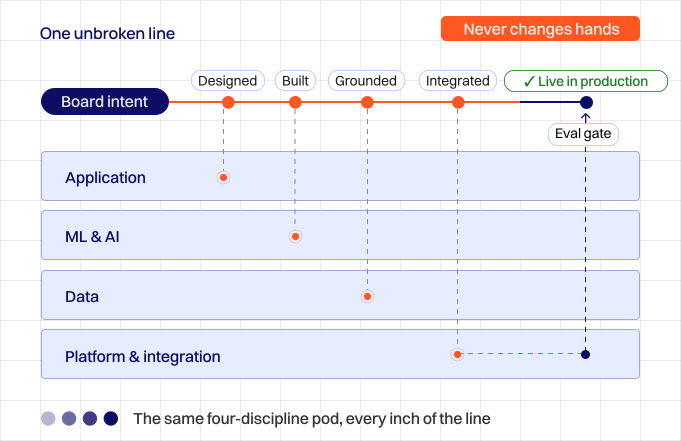
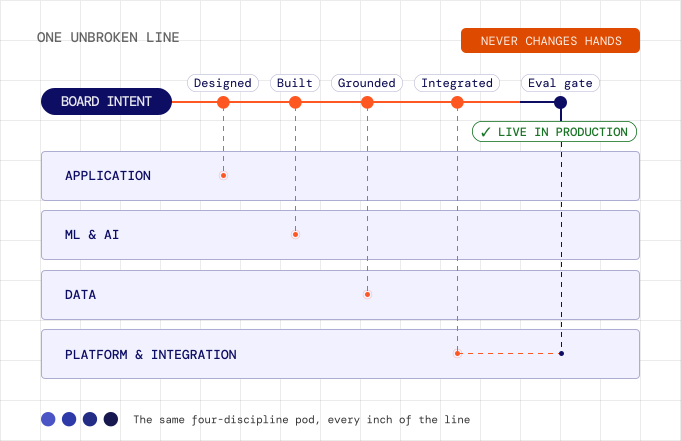
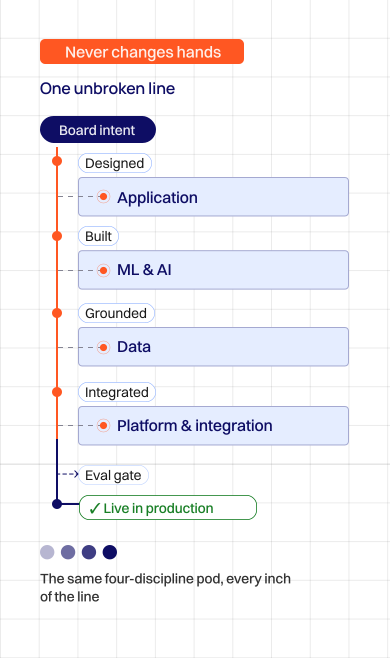
ML, data, application, and platform engineers on one team with one backlog. The same pod carries the work from first design through integration and into production, and every release clears evals before it ships.
  • ML engineers: Models, evals, fine-tuning.
  • Data engineers: Pipelines, quality, foundations.
  • Application engineers: The tools your people use every day.
  • Platform engineers: Integration, security, scale.
img

Zunō platform

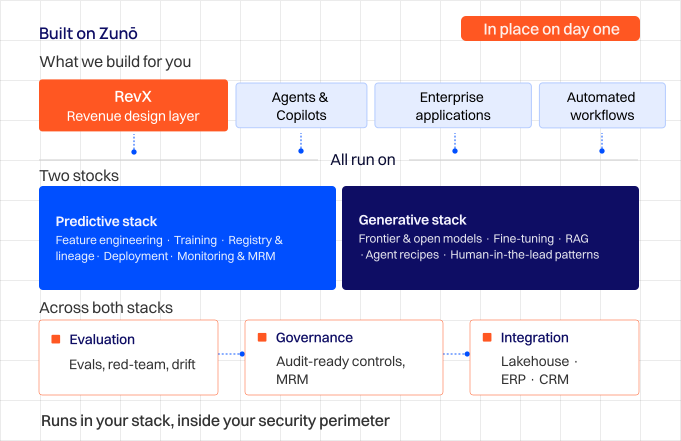
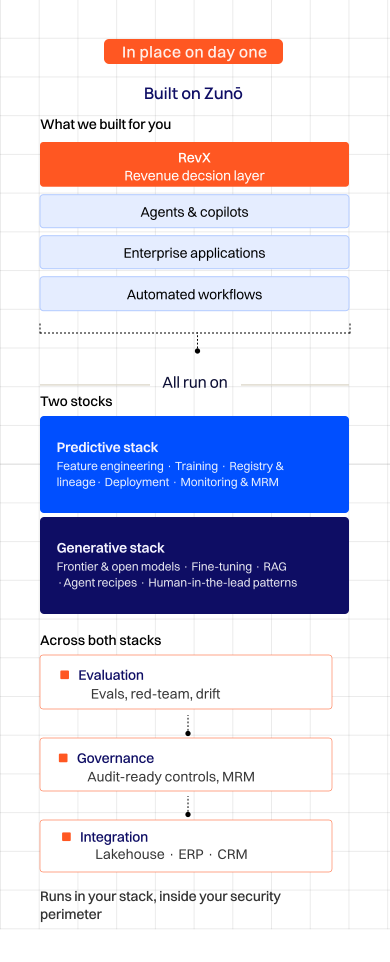
Zunō is the platform underneath every engagement. Foundation models, build recipes, evaluation, governance, and integration are in place on day one, in your stack and inside your security perimeter. That head start is how a first release lands inside a quarter.
  • Foundation models: Frontier and open, tuned to the task.
  • Recipes: Proven patterns for agents, applications, and workflows.
  • Evaluation and governance: Task-realistic evals, audit-ready controls.
  • Integration: ERP, CRM, and the core systems you already run.
img

Embedded leadership

AI strategists and principal architects who work from inside your organization for the length of the engagement. They turn board intent into strategy, design solutions your organization can run, and lead the adoption work that decides whether any of it matters: the workflows, the operating rhythm, the people whose day changes.
  • Senior AI strategists, fluent in the boardroom and the build
  • Principal architects across AI, data, applications, and integration
  • On site or fully embedded, matched to your operating rhythm
  • Accountable to your leadership, not to a change-order process
img

Cross-functional engineering

ML, data, application, and platform engineers on one team with one backlog. The same pod carries the work from first design through integration and into production, and every release clears evals before it ships.
  • ML engineers: models, evals, fine-tuning
  • Data engineers: pipelines, quality, foundations
  • Application engineers: the tools your people use every day
  • Platform engineers: integration, security, scale
img

Zunō platform

Zunō is the platform underneath every engagement. Foundation models, build recipes, evaluation, governance, and integration are in place on day one, in your stack and inside your security perimeter. That head start is how a first release lands inside a quarter.
  • Foundation models: Frontier and open, tuned to the task.
  • Recipes: Proven patterns for agents, applications, and workflows.
  • Evaluation and governance: Task-realistic evals, audit-ready controls.
  • Integration: ERP, CRM, and the core systems you already run.
Diagram showing Zunō platform components: at top, orange box labeled 'RevX Revenue decision layer' above light blue boxes labeled 'Agents & copilots,' 'Enterprise applications,' and 'Automated workflows.' Below, the text 'All run on' points to two blue stack sections: 'Predictive stack' with feature engineering, training, registry, deployment, monitoring, MRM, and 'Generative stack' with models, fine-tuning, RAG, agent recipes, human-in-the-lead patterns. Below, three connected orange-outlined boxes labeled 'Evaluation' with evals, red-team, drift; 'Governance' with audit-ready controls, MRM; and 'Integration' with Lakehouse, ERP, CRM. Text at bottom states the platform runs in your stack inside your security perimeter.

How each engagement runs

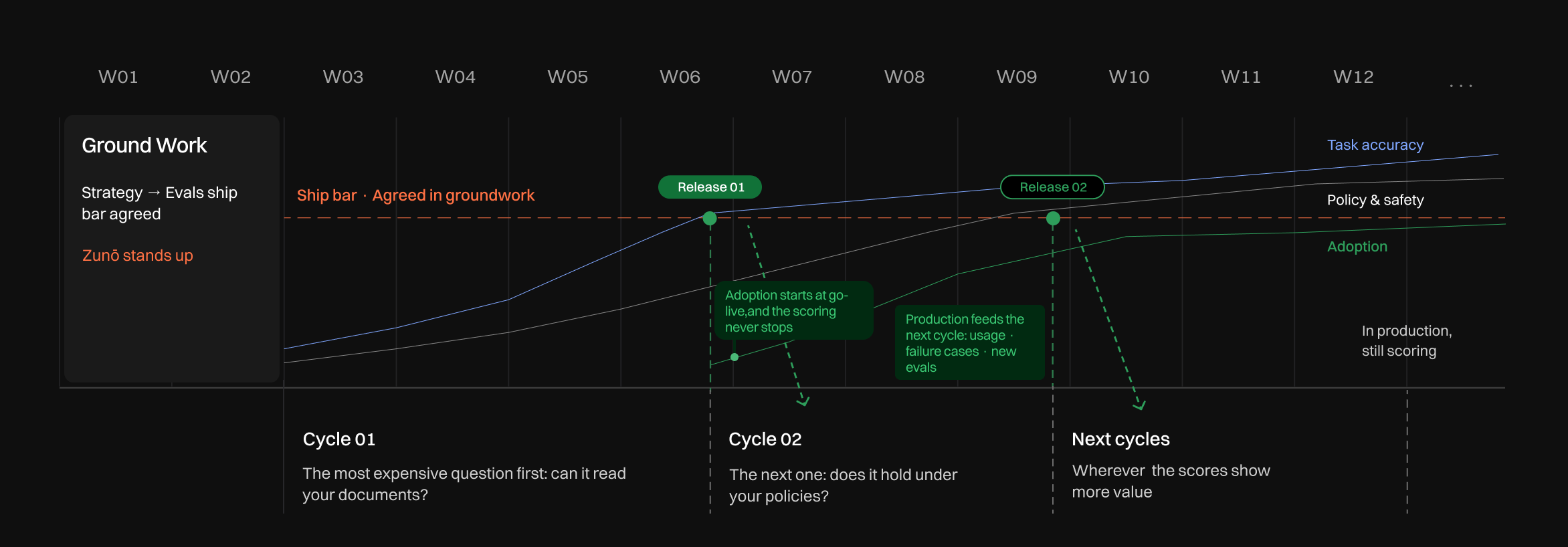
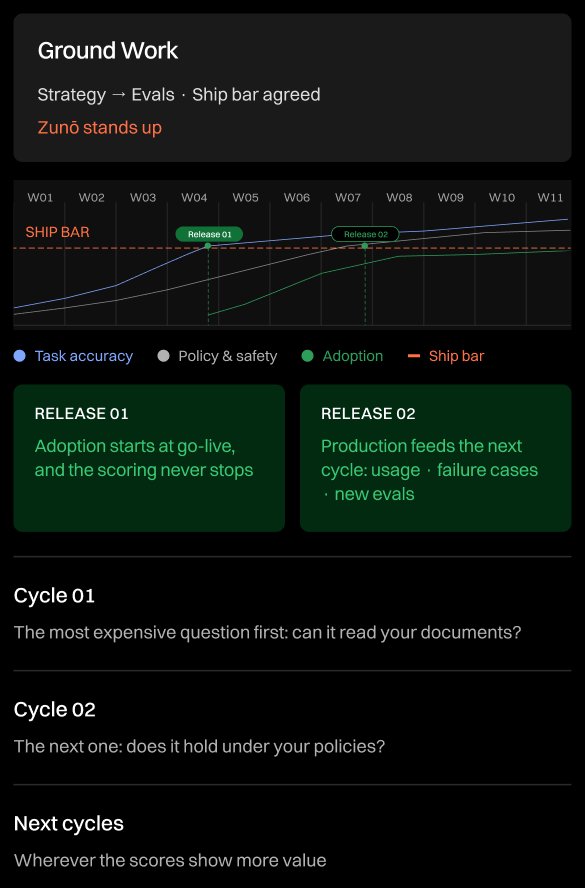
Two weeks of groundwork end with your strategy written as evals: what the system must do in your business, and the bar it must clear to ship. Every cycle after that exists to move the scores.

WEEKS 1 & 2

Groundwork

We move in. Strategists and architects map where AI pays off, set the architecture and the governance posture, and write the strategy as evals: the tests the system must pass before it touches production. The eval set is the PRD. Zunō stands up inside your perimeter.

EVERY 3 TO 4 WEEKS

A cycle

Cycles take the most expensive question first. Frame the slice, design it, build it, run it. A release ships when it clears the evals, not when the demo looks good.

FROM GO-LIVE

Run

Go-live is where the learning accelerates: the evals keep scoring drift, cost, and adoption, and what users actually do comes back as new evals and next-cycle scope. Production teaches. The next cycle applies it.

First release by week six. The scoreboard decides everything after.

Frequently asked questions

How is FDE+ different from standard forward-deployed engineering?

Standard FDE fields engineers. FDE+ adds what a deployment is actually won with: embedded leadership that owns strategy and adoption, and the Zunō platform that starts the work months ahead.

Is this consulting?

No slide is the deliverable. The people who frame the work design it, build it, and run it as one pod with one backlog, accountable to your leadership rather than to a change-order process.

What happens in the first two weeks?

Groundwork. Strategists and architects map where AI pays off and write the strategy as evals: what the system must do in your business, and the bar it must clear to ship. Every cycle after that exists to move the scores.

Who exactly shows up?

Senior strategists fluent in the boardroom and the build, principal architects, and ML, data, application and platform engineers one team, on site or fully embedded, matched to your operating rhythm.

When does an engagement end?

At handoff, not before. The team stays through operations, keeping the work steady as models, data, and the business change, and the engagement ends only when your team can run it without us.

```html
THE PROBLEM
```

Bring your hardest AI problem.
We'll design the production path.

The first call is a working session, not a pitch. Two of our principals, your problem, ninety minutes. You walk out with a plan, a sequence, and a straight answer on whether it's worth doing.